
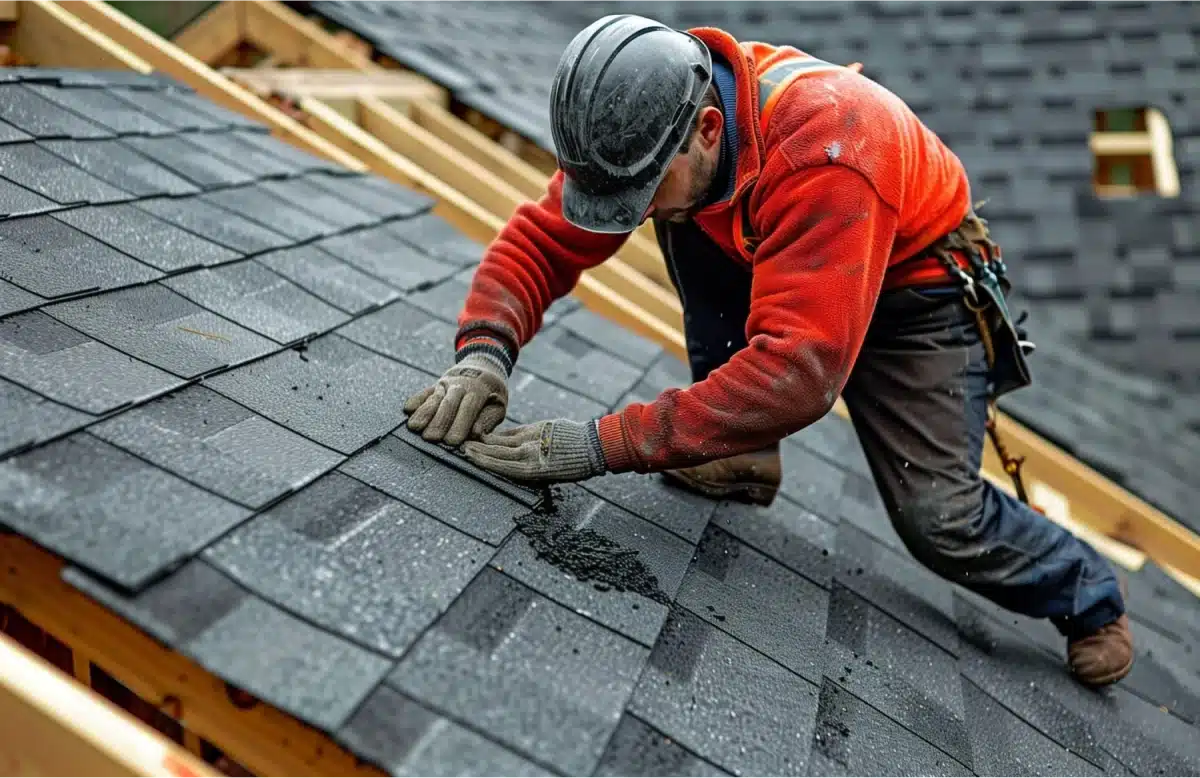
A roof doesn’t fail all at once. It sends signals for months or even years before the first leak shows up in your living room. The homeowners who catch those roof warning signs early spend hundreds on repairs. The ones who don’t spend tens of thousands on emergency replacements, water damage restoration, and mold remediation.
Here are the 10 signs your roof is telling you something, ranked by how fast they get expensive.
1. Water Stains on Your Ceiling or Walls
If you see brown or yellow rings spreading on your ceiling, water is already getting through. That stain might be directly below the leak, or the water may have traveled along a rafter or pipe before dripping down. Either way, the damage is active.
A small ceiling stain costs $300 to $600 to trace and patch. Wait six months, and you’re looking at rotten decking, ruined insulation, and potential mold remediation starting at $2,000.
2. Missing, Cracked, or Curling Shingles
Shingles that are cracked, curling at the edges, or completely missing leave the underlayment exposed to UV and moisture. One or two missing shingles after a storm is a quick roof repair, usually under $200. But a roof with widespread curling or cracking is telling you the material has reached the end of its useful life.
Curling typically starts around year 15 to 18 on standard architectural shingles in Texas heat. Once it starts, it accelerates. You’ve got about 12 to 18 months before those curled shingles start letting water through.
3. Granule Buildup in Your Gutters
Those dark, gritty piles in your gutters aren’t dirt. They’re the protective granules wearing off your shingles. Some granule loss is normal in the first year after installation. After that, heavy accumulation means your shingles are degrading faster than they should.
Without granules, the asphalt mat underneath is exposed to direct UV radiation. In a Texas summer, that unprotected mat bakes, cracks, and fails. If your gutters look like a sandy beach after every rain, it’s time for a professional inspection.

4. Sagging Roof Deck
A roof line that dips, sags, or looks wavy is a structural red flag. Sagging means the decking underneath your shingles is absorbing moisture and weakening. In severe cases, the rafters or trusses themselves may be compromised.
This is not a “wait and see” situation. A sagging deck can eventually collapse, especially under the weight of ponded rainwater or a person walking on it. Get a structural inspection immediately.
5. Daylight Visible Through the Attic
Go into your attic during the day. Turn off the lights. If you see pinpoints of light coming through the roof boards, water is getting in the same way. Those gaps may be around penetrations (pipes, vents, chimneys) or along seams where decking panels meet.
6. Flashing Damage Around Chimneys and Vents
Flashing is the metal strips that seal the joints where your roof meets a wall, chimney, skylight, or vent pipe. When flashing rusts, lifts, or separates, it creates a direct path for water. Flashing failures are one of the most common causes of roof leaks and one of the cheapest to fix, usually $200 to $500 per area.
7. Moss, Algae, or Dark Streaks on the Roof
Green moss or black algae streaks aren’t just cosmetic. Moss holds moisture against the shingle surface, accelerating decay. Algae feeds on the limestone filler in shingles. In humid climates or shaded areas, unchecked growth can cut years off your roof’s lifespan.
8. Higher Energy Bills With No Explanation
Your roof does more than keep water out. It’s a major part of your home’s thermal envelope. If your energy bills jump 15% to 25% without a rate increase or usage change, your roof’s ventilation or insulation may be failing. Poor attic ventilation traps heat, forces your AC to work overtime, and bakes your shingles from below.
9. Roof Is Over 20 Years Old
Standard architectural shingles in Texas have a functional lifespan of 15 to 25 years, depending on ventilation, maintenance, and storm exposure. If your roof is over 20, it doesn’t necessarily need replacement today. But it needs an annual inspection. Problems that would be minor on a 10-year-old roof become critical on a 20-year-old one.
10. Neighbors Are Getting New Roofs
Houses in the same neighborhood were typically built within a few years of each other, with similar materials, by the same builders. If three houses on your street are getting new roofs, yours was probably built to the same spec and has the same age-related wear. It’s worth an inspection even if you haven’t noticed problems yet.
Every one of these roof warning signs gets more expensive the longer you ignore it. A $400 flashing repair becomes a $4,000 deck replacement. A $200 shingle patch becomes a $12,000 full roof replacement with water damage remediation on top. Call Cox Brothers Roofing at (361) 277-0014 to schedule a free inspection and catch the small problems before they become big ones.